Biomass Fuel for Textile and Dyeing Factories: The Complete Guide to Sustainable Steam
Steam is the lifeblood of the textile and garment industry. From pre-treatment and dyeing to washing, bleaching, and stenter finishing, fabric processing demands massive volumes of high-pressure, uninterrupted thermal energy.
However, factory owners and utility managers face a severe double bind. Fossil fuel prices—particularly furnace oil, diesel, and natural gas—continue to fluctuate unpredictably, driving production budgets through the roof. At the same time, major global fashion buyers and international certification bodies are enforcing strict decarbonization mandates on their supply chains.
Adopting biomass fuel for textile manufacturing has quickly evolved from an experimental green trend into an operational necessity. Here is everything you need to know about why fabric dyeing and finishing plants are turning to biomass, and how it directly benefits your bottom line.
Quick Answer
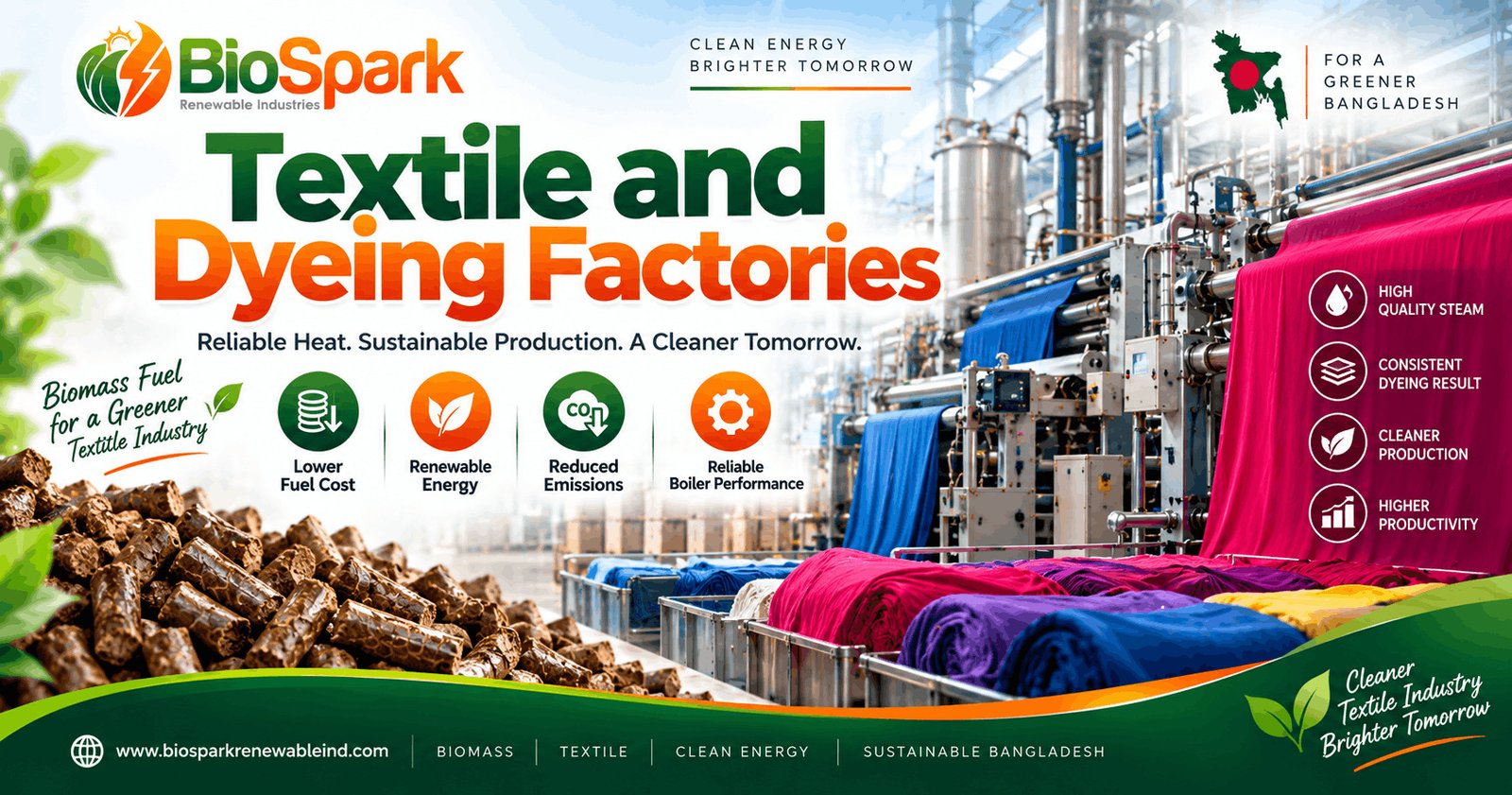
Biomass fuel for textile mills—primarily in the form of compressed biomass briquettes—serves as a high-efficiency replacement for coal, natural gas, and furnace oil. It provides the sustained calorific value (3,800 to 4,800 kcal/kg) required to maintain continuous, high-pressure steam across dyeing vessels. By switching to biomass, textile plants cut steam generation costs by up to 30–40%, eliminate toxic sulfur emissions, and secure essential compliance ratings like Higg FEM and LEED certifications demanded by international apparel brands.
The Steam Challenge in Fabric Dyeing and Finishing
Dyeing and textile wet-processing are notoriously heat-intensive. Unlike light manufacturing facilities that require intermittent heat, a fabric dyeing plant operates continuous cycles where thermal stability is critical Biomass fuel for textile.
- Exact Temperature Control: Dye uptake requires stable liquor temperatures. Sudden pressure drops in the steam line cause patchy shades, uneven dye absorption, and ruined fabric batches.
- Massive Thermal Load: Dyeing vessels, yarn drying chambers, and drying stenters require boilers to maintain constant steam pressure under heavy, fluctuating loads.
- Specific Steam Consumption (SSC): Every meter of processed fabric carries a direct steam cost. If your boiler fuel is inefficient, your cost-per-kilogram of finished fabric rises, erasing your margin in a competitive global market.
To protect fabric quality and keep production lines moving, your boiler needs a fuel that produces immediate, high-output heat without unpredictable dips in temperature.
Why Traditional Boiler Fuels Are Failing Modern Textile Mills
Historically, textile mills relied on three primary sources: furnace oil, grid gas, and coal. Today, all three present steep operational and financial roadblocks:
1. Natural Gas and Furnace Oil
While gas and oil burn cleanly, pipeline gas pressure in major manufacturing zones is increasingly unreliable, forcing plants to run on costly liquid backup fuels. Furnace oil and diesel run at prohibitively high prices, turning daily steam production into an unsustainable financial burden.
2. Industrial Coal
Coal provides dense thermal output at a lower initial purchase price, but it carries catastrophic environmental consequences. Coal generates high sulfur dioxide ($SO_2$) emissions, produces toxic fly ash, and corrodes boiler tubes. More importantly, global fashion brands are aggressively phasing out suppliers who rely on coal-fired boilers.
Core Advantages of Biomass Fuel for Textile Boilers
High-density biomass briquettes engineered from agricultural residues (such as rice husk, sawdust, and plant stalks) provide a reliable, modern alternative. Here is why they are outperforming fossil fuels in textile boiler rooms:
1. Consistent, High-Pressure Steam Output
High-quality biomass briquettes provide a Gross Calorific Value (GCV) of 3,800 to 4,800 kcal/kg. Because quality briquettes are compressed under extreme hydraulic pressure, they burn slowly and evenly. This eliminates the rapid thermal spikes and dips common to raw wood logs or loose biomass waste, ensuring steady steam pressure across every dyeing vessel.
2. Drastic Reduction in Steam Generation Costs
Biomass briquettes are made from regional agricultural byproducts, shielding factory owners from global oil price volatility and currency fluctuations. Compared to furnace oil or diesel, switching to solid biomass briquettes can slash fuel overhead for steam production by 30% to 40%.
3. Effortless International Buyer Compliance
If your factory exports garments to Europe or North America, sustainability is no longer optional. Switching to carbon-neutral biomass fuel directly improves your Higg Index (Higg FEM) scores and supports LEED Green Building standards. Demonstrating that your fabric is processed using clean, renewable thermal energy makes your factory a preferred vendor for eco-conscious global retailers.
4. Reduced Boiler Grate Maintenance and Ash Handling
Unlike coal, which can leave behind up to 30–40% abrasive, clinker-forming ash, premium biomass briquettes typically produce only 5% to 15% clean, organic ash. This means fewer shutdowns for grate scraping, no tube clinkering, and significantly lower ash disposal fees.
Selecting the Right Biomass Specification for Textile Plants
Not all biomass fuel delivers the same performance. To maintain continuous steam without choking your boiler feed systems, ensure your briquette supplier meets the following technical parameters:
- Moisture Content (<10%): Excess moisture wastes energy boiling off water instead of generating usable steam.
- Mechanical Durability: Briquettes must be dense enough (>1,000 kg/m³) to avoid crumbling into dust during mechanical feeding.
- Low Ash & Silica Content: Sourcing fuels with controlled mineral content prevents grate fouling and slagging during intense 24/7 production runs.
Biomass fuel for textile
The South Asian Landscape: The RMG Sector in Bangladesh
In major garment manufacturing hubs like Bangladesh, securing economical, compliant energy is the single biggest factor in sustaining export growth. With industrial gas shortages and tightening environmental policies, Biomass Fuel for Textil the readymade garment (RMG) sector is rapidly transitioning to biomass briquettes.
By sourcing biomass fuel refined from abundant regional rice husks and timber processing residues, Bangladeshi textile mills create a self-sustaining circular economy. They eliminate reliance on dirty imported coal, insulate their balance sheets from volatile currency exchanges, and solidify their status as the world’s leading green garment manufacturing hub.
Transform Your Boiler Efficiency Today
Upgrading your boiler fuel does not require replacing your existing boiler infrastructure. Most solid-fuel industrial boilers can transition to high-performance biomass briquettes with minimal to zero modifications.
Biomass Fuel for Textil
Cut Your Steam Costs with BioSpark
Ready to transition to a cleaner, more affordable energy source for your textile plant? Contact BioSpark Renewable Industries today. Our team will conduct a comprehensive fuel cost comparison for your facility and deliver sample biomass briquettes tailored to your boiler specifications.
Conclusion
For textile and fabric dyeing factories, energy is not just a utility—it is the foundation of product quality and profit margins. Burning costly furnace oil or polluting coal is no longer viable in a world focused on green manufacturing and lean margins.
Deploying biomass fuel for textile boilers bridges the gap between commercial profitability and environmental responsibility. It provides the steady, high-pressure steam required for flawless fabric finishes while protecting your enterprise from volatile fossil fuel markets the best Biomass Fuel for Textil .
Frequently Asked Questions (FAQs)
1. Can biomass fuel maintain steady pressure for fabric dyeing machines?
Yes. Unlike loose agricultural waste, high-density biomass briquettes burn with uniform thermal consistency. As long as the briquettes have a consistent calorific value (above 3,800 kcal/kg) and low moisture (under 10%), they easily sustain the continuous, high-pressure steam required for sensitive fabric dyeing cycles.
2. Is biomass fuel for textile boilers accepted by international apparel buyers?
Yes, international apparel brands actively encourage and favor suppliers using biomass fuel. Because biomass is recognized as a carbon-neutral, renewable energy source, using it significantly improves your Higg FEM (Facility Environmental Module) score and aligns with international decarbonization roadmaps.
3. How much can a dyeing plant save by switching from furnace oil to biomass?
Most wet-processing and dyeing operations save between 30% and 50% on operational steam costs after transitioning from furnace oil or diesel to compressed biomass briquettes, depending on local fuel pricing and current boiler efficiency.
4. Does burning biomass fuel create smoke that can stain or damage finished fabrics?
No. When burned in a properly tuned boiler with correct air-to-fuel ratios, high-density biomass briquettes achieve near-complete combustion with virtually zero visible smoke. Furthermore, industrial exhaust gases are safely discharged through factory chimneys, keeping processing and finishing floors completely isolated and clean.
5. Do we need to replace our existing coal boiler to use biomass fuel?
In most cases, no. Industrial boilers designed to burn solid fuels like coal can seamlessly burn biomass briquettes with little to no modification to the feeding system or grate. Plant operators usually only need to make minor adjustments to the draft fans and air intake to achieve optimal combustion.