Best Affordable Industrial Alternative Fuel in Bangladesh: A Practical Guide
Industrial manufacturing across Bangladesh is at a decisive turning point. Whether operating a composite textile mill in Gazipur, a pharmaceutical unit in Narayanganj, or a food processing plant in Bogura, energy costs directly dictate profit margins.
For decades, Bangladeshi factories relied on low-cost pipeline natural gas or imported fossil fuels. Today, that playbook no longer works. Severe natural gas pressure drops frequently halt production lines, while global supply crunches and foreign currency pressures have sent the landed cost of imported coal and furnace oil skyrocketing.
To stay competitive and protect export margins, plant owners and utility engineers are actively transitioning to an industrial alternative fuel that delivers dependable, high-heat energy without breaking operational budgets.
Quick Answer
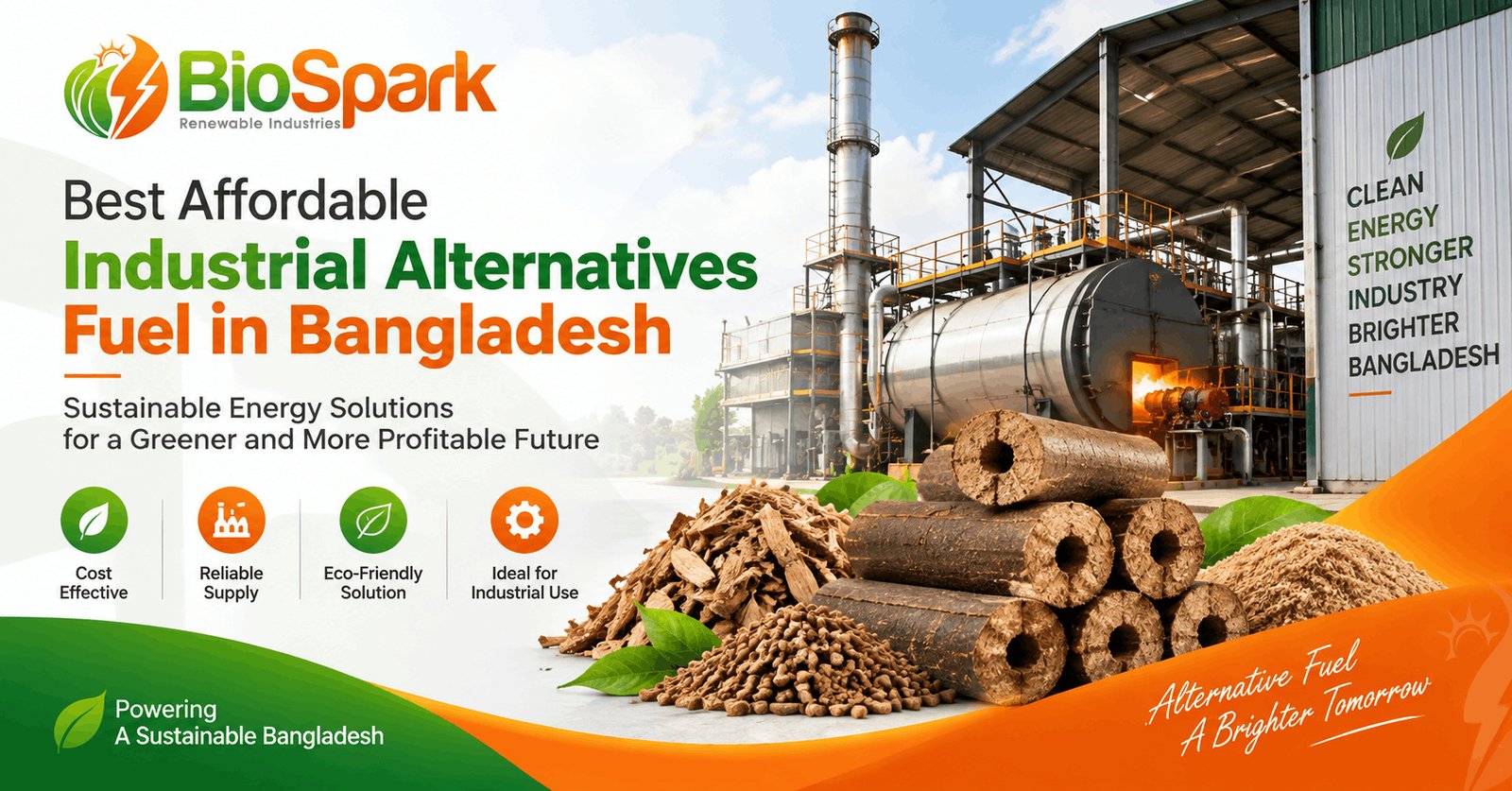
The most affordable and technically viable industrial alternative fuel in Bangladesh today is densified biomass briquettes. Refined from domestically abundant agricultural residues (such as rice husk, sawdust, and jute sticks), biomass briquettes deliver a Gross Calorific Value of 3,800 to 4,800 kcal/kg. They cost 30% to 40% less than furnace oil and diesel per unit of steam, produce 70% less ash than low-grade imported coal, eliminate volatile foreign exchange exposure, and satisfy stringent global buyer decarbonization mandates.
The Industrial Energy Dilemma in Bangladesh
Understanding why Bangladeshi factories are shifting energy strategies requires examining the failure points of traditional fuel sources:
1. Unreliable Natural Gas Availability
Gas supply constraints and fluctuating pipeline pressures routinely force industrial steam boilers to cycle down. Idle dyeing vessels and cold ironing lines destroy scheduled batch times, making reliance on pipeline gas a major operational liability.
2. Imported Fossil Fuel Cost Volatility
Coal, heavy furnace oil (HFO), and diesel are priced against international spot markets and foreign currency reserves. When global freight rates rise or import duties shift, a factory’s per-hour steam generation costs spike overnight, eroding razor-thin production margins.
3. Stricter Environmental Mandates from Global Buyers
The ready-made garment (RMG) sector faces relentless pressure from international fashion brands and European compliance boards. Facilities burning high-sulfur coal or unfiltered fuel oil risk failing environmental audits, receiving poor Higg Index (Higg FEM) scores, and losing high-value export contracts.
Evaluating Industrial Alternative Fuel Options in the Local Market
When searching for an industrial alternative fuel, plant managers must evaluate actual thermal efficiency, local availability, and ease of equipment operation. Here is how the primary contenders stack up:
1. Compressed Biomass Briquettes (The Clear Frontrunner)
Biomass briquettes are produced by compressing dried agricultural waste under intense mechanical or hydraulic pressure without toxic chemical binders.
- Performance: Delivers a reliable Gross Calorific Value (GCV) between 3,800 and 4,800 kcal/kg.
- The Advantage: High volumetric density allows slow, steady combustion. Low moisture content (<10%) ensures immediate heat transfer to boiler tubes without energy lost to water evaporation.
2. Raw, Loose Agro-Waste (Rice Husk & Wood Shavings)
Directly burning uncompressed agricultural waste is a common ad-hoc practice in rural boiler operations.
- Performance: Unpredictable thermal output with high volume consumption.
- The Limitation: Loose material is bulky and expensive to transport and store. Its variable moisture content causes heavy smoke, clogging boiler grates and failing basic particulate emission standards.
3. Rooftop Solar Thermal Pre-Heating (Support Systems)
Solar thermal systems use collectors on factory roofs to pre-heat water before it enters the boiler drum.
- Performance: Highly effective as a hybrid booster system.
- The Limitation: Solar systems cannot independently produce high-pressure saturated steam required around the clock. They serve best as a supplemental system alongside a solid fuel setup.
4 Reasons Biomass Briquettes Lead Industrial Alternatives
For heavy heat and continuous steam applications, biomass briquettes outperform other fuel sources across every operational metric:
- Substantial Steam Cost Reductions: Switching from furnace oil or liquid diesel to high-density biomass briquettes slashes daily boiler fuel expenses by 30% to 40%, insulating operations from global oil market shocks.
- Immunity to Import Bottlenecks: Because briquettes are manufactured domestically using local harvest residues, supply chains remain stable year-round, completely unaffected by international shipping delays or currency exchange issues.
- Low Ash Content & Equipment Protection: Quality biomass briquettes contain only 5% to 15% mineral ash, compared to 25% to 40% in low-grade imported coal. This eliminates heavy clinker formation on boiler grates, preserves heat exchanger tubes, and drastically reduces downtime for ash cleanouts.
- Carbon-Neutral Compliance: Biomass is categorized as an organic, carbon-neutral fuel. Burning briquettes helps facilities achieve high Higg FEM ratings and LEED green building standards, securing competitive advantages during buyer compliance reviews.
Operational Transition: Converting Your Boiler Setup
Switching to a modern industrial alternative fuel does not require scrapping your existing capital equipment.
If your facility operates a solid-fuel boiler (such as a chain-grate or fluidized-bed unit built for coal), biomass briquettes can be introduced immediately with minimal adjustments to the draft fans and secondary air dampers. If your facility runs purely on gas or liquid oil, retrofitting or installing an auxiliary solid-fuel boiler typically delivers a return on investment (ROI) within 8 to 14 months based on fuel cost savings alone.
Conclusion
Continuing to operate industrial boilers on expensive imported fossil fuels or unpredictable natural gas lines exposes manufacturers to severe financial and operational risks.
Adopting a verified, high-efficiency industrial alternative fuel—particularly manufactured biomass briquettes—delivers immediate fuel savings, stabilizes daily steam output, and protects factory export contracts through robust environmental compliance. The future of resilient industrial manufacturing in Bangladesh starts inside the boiler room.
Ready to Lower Your Factory’s Steam Generation Costs?
Take control of your utility budget today. Contact BioSpark Renewable Industries to schedule an on-site boiler fuel assessment. Our engineering team will analyze your steam load, calculate your exact monthly cost savings, and provide trial batches of premium, lab-certified biomass briquettes tailored to your equipment.
Frequently Asked Questions (FAQs)
1. What makes biomass briquettes the most reliable industrial alternative fuel in Bangladesh?
Biomass briquettes combine high thermal density (3,800–4,800 kcal/kg) with low moisture and ash content. Because they are manufactured locally from steady agricultural cycles (such as rice milling and timber processing), factories obtain a dependable fuel supply at a predictable, domestic-currency price.
2. How do steam costs compare between furnace oil and biomass briquettes?
Generating steam using premium biomass briquettes is approximately 30% to 50% cheaper than using heavy furnace oil (HFO) or industrial diesel, even when factoring in solid-fuel handling and ash removal labor.
3. Can biomass fuel handle high-pressure steam demands in textile dyeing plants?
Yes. When manufactured under high compression with moisture kept strictly below 10%, biomass briquettes burn with uniform heat intensity, reliably maintaining the constant boiler pressures (8–10 bar or higher) required for sensitive textile dyeing cycles.
4. Will burning biomass briquettes produce excessive smoke or chimney soot?
No. Unlike loose agricultural waste or bituminous coal, high-density briquettes achieve near-total combustion when paired with balanced forced-draft (FD) and induced-draft (ID) boiler airflows, releasing clean, virtually smokeless exhaust gas.
5. Do international fashion brands accept biomass fuel as a green energy source?
Yes. Major apparel buyers and environmental frameworks (such as the ZDHC roadmap and Higg Index) recognize biomass as a renewable, carbon-neutral substitute for fossil fuels, helping suppliers maintain preferred vendor statuses.